The Complete AI Prompt Checker Guide: How to Write Prompts That Actually Work (2026)
If you’ve ever gotten a vague, generic, or “not quite right” answer from ChatGPT, Claude, or Gemini, the problem usually isn’t the model — it’s the prompt. This prompt checker guide walks through exactly what to look for before you hit send, so you don’t need to be a prompt engineering expert to get better results — just know what to check. A vague or poorly structured prompt forces the AI to guess your intent, and guessing leads to generic responses, missed details, and sometimes outright hallucinations. You can also try our Prompt Generator if you want help building stronger prompts from scratch.
Most people assume that better AI models automatically produce better answers. In reality, a well-checked prompt does something no model upgrade can: it removes ambiguity, gives the AI clear boundaries, and tells it exactly what “done” looks like. This prompt checker guide brings together the full picture — the core checklist for what makes a prompt good, the mistakes that creep in even after you know the basics, why weak prompts are one of the biggest hidden causes of AI hallucinations, and how to catch all of this quickly using a prompt checker instead of relying on manual review alone. Think of this prompt checker guide as a reusable reference you can come back to before every important prompt.
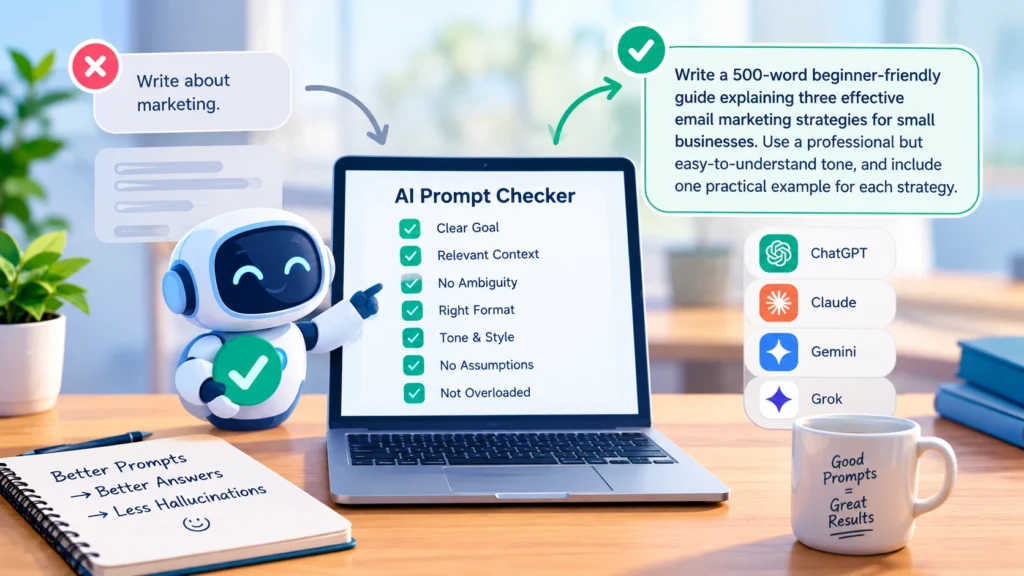
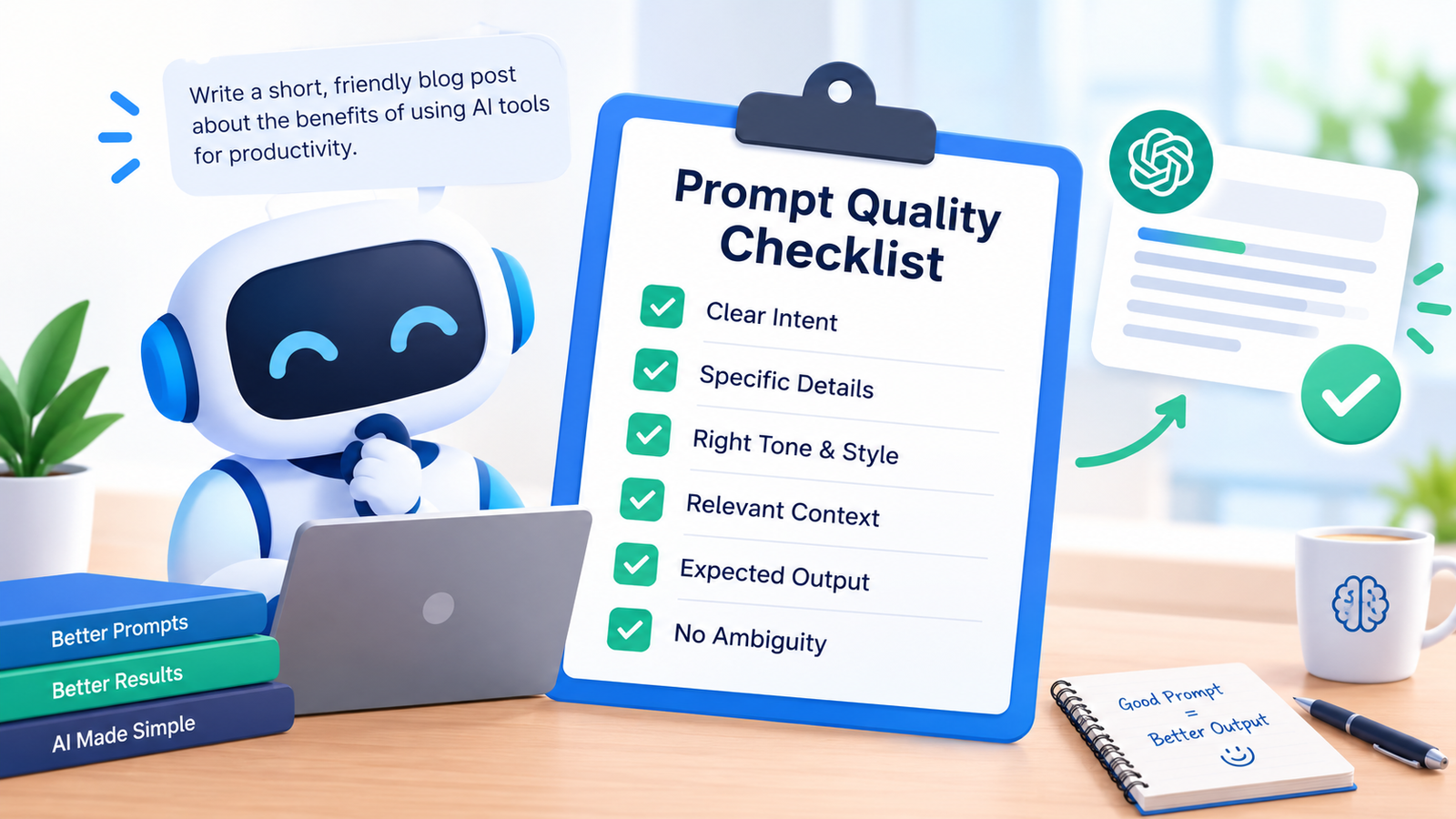
7 Signs Your Prompt Needs Work (Straight From This Prompt Checker Guide)
Before you generate a response, run your prompt through these seven checks.ll
Here’s the difference in action. A weak prompt: “Write about email marketing.” A strong prompt: “Write a 500-word beginner-friendly guide explaining three effective email marketing strategies for small businesses. Use a professional but easy-to-understand tone, and include one practical example for each strategy.” The strong version leaves almost nothing for the AI to guess — which is exactly what a solid prompt checker guide should train you to spot.
Before sending any prompt, run a quick self-test: Could two different people interpret this prompt in two different ways? Have you told the AI who the response is for and what format you want? Are you using an adjective like “good,” “better,” or “professional” without explaining what it means in this context? A “yes” to any of these means your prompt likely needs more detail before you send it.
5 Prompt Mistakes Even Experienced Users Still Make
This part of the prompt checker guide looks at a different problem — not vagueness, but habits that quietly undercut otherwise well-written prompts once you’ve already learned the basics.
Why Vague Prompts Cause Hallucinations (And How a Prompt Checker Guide Helps)
If there’s one lesson this prompt checker guide keeps coming back to, it’s this: a hallucination is when an AI generates something confident-sounding but factually wrong or fabricated, and it’s often the model filling gaps your prompt left open.
To reduce hallucinations: be specific about scope, ask the model to flag uncertainty, break large requests into smaller ones, paste in source material directly, and avoid vague phrasing anywhere accuracy matters. Following this prompt checker guide step by step catches most of these issues before you ever hit send.
Weak structure is one of the biggest hidden causes of hallucination-prone prompts. A prompt without clear boundaries — no defined scope, no stated goal, no format — gives the model too much freedom to fill gaps with invented details rather than honest uncertainty.
Prompt Checker Guide: Manual Review vs. Automated Checking
Once you know what makes a prompt good, you have two ways to check your own prompts before sending them: review them yourself, or run them through a prompt checker tool. Both work, but they catch different things, and one is a lot faster.
Prompt checker |
Manual review |
The best approach combines both. Write your prompt with your goal, audience, and format in mind. Run it through a prompt checker for an instant, objective quality score and specific flags. Apply the fixes that make sense, using your own knowledge of the context. Then do a final quick read-through to confirm the prompt still reflects what you actually need. This gives you the speed and consistency of automated checking, combined with the context-awareness only you have.
You don’t need to memorize a seven-point checklist every time you write a prompt. Our free prompt checker runs these exact checks automatically — flagging ambiguity, missing context, and weak structure — and hands you an instant quality score plus clear, actionable tips on what to fix, before you submit anything to ChatGPT, Claude, Gemini, or any other model. No sign-up, no cost — just paste your prompt in and see exactly what needs work before it costs you a wasted response.
Frequently Asked Questions
Start Using This Prompt Checker Guide Today
You don’t need to memorize a seven-point checklist every time you write a prompt. This prompt checker guide boils down to one habit: check before you send. Our free prompt checker runs these exact checks automatically — flagging ambiguity, missing context, and weak structure — and hands you an instant quality score plus clear tips on what to fix. Bookmark this prompt checker guide and run through it before any prompt that really matters. No sign-up, no cost — just paste your prompt in and see what needs work before it costs you a wasted response.